Questions About the Tradition
The app's own mechanics are covered on the About page. These are questions about the actual tradition the chart is tracing: the history, the titles, and what the traditions themselves say.
What is apostolic succession?
The unbroken chain of bishops consecrating bishops, reaching back to Christ's own apostles.
A bishop is made a bishop by other bishops. Those bishops were made bishops by others before them, and so on, back and back to the apostolic age. At the moment it happens, the older bishops lay their hands on the head of the new one. That gesture, repeated across twenty centuries, is what the ancient Church called the apostolic succession.
The physical act is understood as the sign of something larger: the authority to teach, to ordain, and to care for a people, handed on in continuity with the apostles Christ himself sent out. Whatever you make of that claim, the chain itself is a matter of record. This app is an attempt to lay that record out and let you follow it.
Where does this tradition come from?
It is as old as the early Church itself. But it was an argument in the second century that gave it the shape it still has, and the argument was about who you could trust.
You could name the bishops of the great churches in order, back to the apostles, and see that the teaching had never changed.
The idea is there almost from the beginning. Clement of Rome, writing around A.D. 96, describes the apostles appointing leaders and making arrangements for others to succeed them when they died. Ignatius of Antioch, who had been taught by the Apostle John himself, urged the churches to hold fast to their bishops as the center of their unity.
What turned that instinct into a doctrine was a fight. Around A.D. 180, teachers we now call Gnostics were claiming to possess secret knowledge: truths the apostles had supposedly handed down in private, to a chosen few, and never written anywhere. It is a difficult claim to argue with. Secret knowledge leaves no evidence.
Irenaeus of Lyons found a way. If the apostles had really taught something in secret, he said, the churches they founded would show it. So look at those churches. Name their bishops, one after another, all the way back. The teaching is public, it is continuous, and anyone can check it.
He had unusual standing to make that argument, because he was barely removed from the apostles himself. John taught Polycarp. Polycarp taught Irenaeus. Two links, and Irenaeus had known a man who had known a man who walked with Christ.
That is why this chart counts and names every link, rather than simply asserting that the line exists. It is the same argument Irenaeus made eighteen centuries ago. All this app does is draw it out in full, and let you check it for yourself.
What does "The Right Reverend" mean?
It's the traditional style of address for a bishop: a title of office, not a personal claim.
"Rt." is short for "Right," not "Rite." Those are two different words that happen to sound alike, and the second one gets its own question below. "The Right Reverend" works the way "The Honorable" works for a judge, or "Dr." for a physician. It names the office, it goes before the name, and it is there by long custom rather than by anyone's request.
An archbishop is styled one degree higher: "The Most Reverend." Both titles come from the same English church tradition, which gave clergy their forms of address centuries before this succession ever reached North America or Africa. They were inherited, not invented for this chart.
What does "Reverend" mean, and why not just say "Bishop"?
"Reverend" means "worthy of reverence." It's the base title for any ordained minister; "Bishop" is the specific office layered on top of it.
Every ordained priest is "the Reverend so-and-so." A bishop is a priest who has been given a further, particular office: overseeing a diocese, ordaining others, and carrying the succession forward. So a bishop's full style names both things at once: "The Right Reverend [name], Bishop of [diocese]."
"Bishop" on its own says the job. "The Right Reverend" is simply the customary way English says that job with the respect the office has long been given. And if you have ever wondered whether you are expected to use it, the honest answer is that most bishops will not mind either way.
What is a "Rite"?
A tradition's actual form of worship: the words, actions, and order of a service. Not a title for a person at all.
This is a genuinely different word from the "Right" in "Rt. Rev.," and a fair thing to be confused by, because the two sound identical. A rite is a way of worshipping. The Roman Rite, the Byzantine Rite, and what is often called the Anglican or English Rite are each a distinct tradition of how a service is actually conducted: which words are said, in what order, and with what actions.
The Anglican tradition traced in this chart worships according to its own rite, rooted in the Book of Common Prayer. That sits alongside the apostolic succession this app is about, rather than instead of it. One is how a church prays. The other is how its ministry is handed on.
What is a diocese? What is a see?
The same thing, said two ways. A diocese is the territory and community a bishop oversees; "see" is the older, more formal word for it.
"The See of Fort Worth" and "the Diocese of Fort Worth" name exactly the same place. "See" comes from the Latin sedes, meaning "seat": first the bishop's actual chair in his cathedral, and then, by extension, everything and everyone under his care. If the two words seem to be used interchangeably throughout this app, that is because they are.
What is a province?
A group of dioceses under a shared archbishop.
The Anglican Church in North America, for example, is one province made up of many dioceses, with Fort Worth among them. Each diocese keeps its own bishop and runs its own affairs. The province is the larger household they belong to together, usually under an archbishop, and it is the level at which churches recognize one another across national borders.
Why does a chart about Anglican bishops include the early bishops of Rome?
Because for the first thousand years of this chart, there was no separate "Roman Catholic" church to belong to instead: there was one, undivided Church.
Every bishop of Rome shown here served before the East–West Schism of 1054. The line as traced stops at Vitalian, who died in 672. Naming Rome here is not a claim about the later Roman Catholic Church. It is a statement about the centuries when there was simply the Church, and about the inheritance every Christian tradition alive today still draws from them.
The line reaches England from Rome at a specific, dated moment. In 668, Vitalian consecrated Theodore of Tarsus and sent him to Canterbury. From Theodore onward the succession runs through the archbishops of Canterbury: in Roman obedience until 1054, and after that still Catholic, but no longer answering to Rome.
The second turning point is marked at Thomas Cranmer, Archbishop from 1533. What changed at the Reformation was jurisdiction, not the chain of consecration. The same hands went on being laid on the same heads. That is the whole reason an Anglican chart has to begin in Rome: for the first thousand years, there was nowhere else for it to begin.
Do all Christian traditions understand apostolic succession the same way?
No, and this chart tries to show the shared history fairly, without settling the question any one tradition would have to answer for itself.
This chart presents the historical line itself. What it signifies, the traditions continue to discuss.
The Roman Catholic and Eastern Orthodox churches understand succession as a tactile, sacramental chain. On that view, valid sacraments require bishops consecrated in unbroken personal succession from the apostles, and the physical continuity matters in itself.
The Anglican tradition kept the historic episcopate through the Reformation and still ordains only through bishops standing in that line. When Matthew Parker was consecrated Archbishop of Canterbury in 1559, care was taken that his own consecrators held valid orders reaching back before the Reformation. That care was deliberate, and it is a large part of why the English succession is traceable at all.
Even within Anglicanism, people differ on what the succession actually conveys. Some emphasize the tactile line of consecration itself. Others emphasize the succession of apostolic teaching that the line stands for. Both readings are held by churches traced in this app, and this app does not try to settle between them. It shows you the line. What the line means is a conversation the churches are still having.
Why does a card often name only one consecrating bishop?
Because that is what the canons require to be certain of, not because he acted alone.
Three bishops are required. Only one of them is required for validity. That is why the other names so often go unrecorded.
Since the Council of Nicaea in 325, a bishop has been consecrated by at least three bishops, and Anglican canons carry that rule forward. But the rule exists for two practical reasons: so that the whole college of bishops is visibly represented, and so that the Church can be certain the consecration was valid. Validity needs only one of the three.
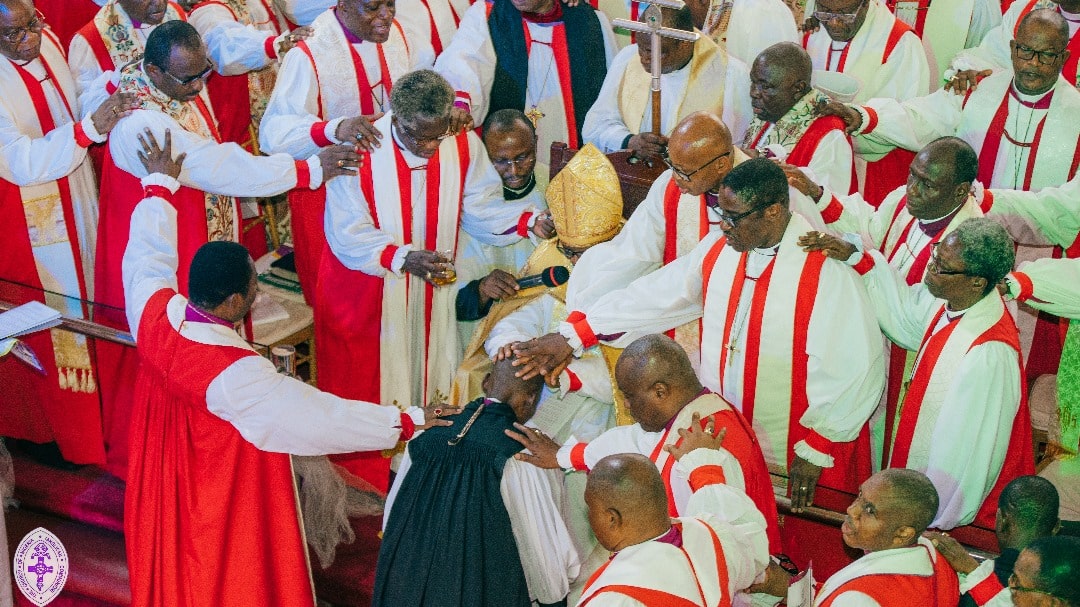
So the individual names carry no canonical weight once a valid presiding bishop and the minimum number are there. In practice far more than three take part: a photograph of a Nigerian consecration shows well over a dozen bishops with hands extended or resting on the candidate at the same moment. There is simply no reason for the record to list them, and usually it does not. Reports give the date, the cathedral, and the archbishop who presided. Even a printed order of service does not: it names the preacher and the presenters, but not the laying on of hands.
One group is different. In the ACNA, consecrations are recorded bishop by bishop, because a young province has to coordinate deliberately to gather the three that canon law requires. That shows plainly in this chart: of the ACNA entries here that record consecrators at all, eighteen name three or more bishops. Of the hundred and thirty-two Nigerian entries that record consecrators, not one does.
So where a card names a single bishop and marks him “(presiding)”, read it this way: he is the bishop the record happens to name, and the others are unknown rather than absent. We could fill in the likely names, and the chart would look more complete. It would also be less true, so we do not.
Why does Latvia's line pass through the Church of Sweden?
Because a line of succession runs through whoever actually consecrated whom, and twice, that was a bishop of Sweden.
Latvia's own apostolic succession runs through the Church of Sweden, so this chart shows that part of Sweden's line too, gratefully, the way any line shows what it grew from.
The Evangelical Lutheran Church of Latvia is in full communion with the ACNA and the wider Global Anglican Communion (GAC), the fellowship GAFCON's provinces reorganized into in March 2026, and Archbishop Jānis Vanags of Riga has been received as a fellow bishop. Its own succession, though, was twice consecrated from Sweden, so this chart follows that part of Sweden's line as far as it needs to, the same way it follows the bishops of Rome as far as Canterbury's own line begins.
Its own succession, though, came twice from Sweden. So this chart follows that part of Sweden's line as far as it needs to, in the same way it follows the bishops of Rome as far as Canterbury's own line begins.
The first time was in 1922. The Latvian church was being restored after the First World War, and Archbishop Nathan Söderblom of Uppsala consecrated Kārlis Irbe as its first bishop.
The second time came out of a much harder period. Under Soviet occupation, Gustavs Tūrs was elected Archbishop in 1948 but was never formally consecrated, for political reasons, and led the church in that uncertain status until he resigned in 1968. Two men elected to succeed him, Pēteris Kleperis and Alberts Freijs, both died before they could be enthroned.
Not until September 1969 did Bishop Sven Danell of Skara consecrate Jānis Matulis, giving Riga a validly consecrated Archbishop again after more than two decades without one. Matulis was handed the pastoral staff of Kārlis Irbe, the church's first bishop, as a deliberate sign that the line of 1922 had not been abandoned.
That is worth sitting with, because it is what apostolic succession actually claims. The chain is a record of hands laid on heads. It runs through the bishops who were there, in the order they were there. Leaving that part out would not make Latvia's line shorter: it would only make it untraceable.
What is GAFCON, and what's the difference between the Global Anglican Communion and the Global Anglican Council?
GAFCON began in 2008 as a fellowship of Anglicans responding to disagreements over Scripture and sexuality. In October 2025 its primates stopped recognizing Canterbury as the Communion's center, and in March 2026 they reorganized into the Global Anglican Communion (what this chart abbreviates GAC), led by a new Global Anglican Council, chaired by Archbishop Laurent Mbanda of Rwanda.
"...Anglican identity is not determined necessarily through recognition by the Archbishop of Canterbury." — The Jerusalem Statement, 2008
Many of the provinces this chart traces trace their modern history through GAFCON, the Global Anglican Future Conference. Nigeria, Kenya, Uganda, Rwanda, Tanzania, the ACNA, Alexandria, South Sudan, Myanmar, the Congo, South America, Chile, Brazil and the Anglican Network in Europe are all part of that story. It is a real and significant relationship, and in October 2025 it changed in a way worth explaining plainly rather than leaving unsaid.
The disagreement GAFCON grew out of already had a documented history by 2008. In 2003, The Episcopal Church consecrated Gene Robinson, a bishop in an active same-sex relationship. Nobody went into it blind. Weeks earlier, at their October 2003 meeting, thirty-seven Anglican primates, including The Episcopal Church's own presiding bishop, had warned together that going ahead would "tear the fabric of our Communion at its deepest level, and may lead to further division."
The consecration went ahead anyway. On 31 October 2003, thirteen primates issued a joint statement refusing to recognize it. They pointed to the Communion's own 1998 Lambeth Conference Resolution I.10, which had already called homosexual practice "incompatible with Scripture."
GAFCON's first conference met in Jerusalem five years later, from 22 to 29 June 2008. It drew 1,148 lay and clergy delegates, among them 291 bishops, from 29 countries. Seven primates led it and became the founding GAFCON Primates' Council: Peter Akinola of Nigeria, Justice Akrofi of West Africa, Benjamin Nzimbi of Kenya, Emmanuel Kolini of Rwanda, Henry Luke Orombi of Uganda, Valentino Mokiwa of Tanzania, and Gregory Venables of the Southern Cone of South America, the same Venables who heads this chart's own South America line. The American bishops Robert Duncan and Martyn Minns took part too, a year before the dioceses they led helped found the ACNA in 2009.
On 29 June 2008 the conference issued the Jerusalem Declaration: fourteen tenets naming what it held to be the non-negotiable ground of Anglican identity. It named the full authority of Scripture, the three historic Creeds and the four Ecumenical Councils, the Thirty-Nine Articles, and the 1662 Book of Common Prayer.
It treated two live disputes quite differently, in its own words. On the ordination of women as priests or bishops, it acknowledged "freedom in secondary matters" among orthodox Anglicans rather than settling the question. That echoed the Communion's own 1988 Lambeth resolution, which had left the decision to each province. On sexuality, it treated Lambeth's 1998 Resolution I.10 as already settled and not open to revision.
On 3 October 2025, the Church of England named Sarah Mullally the first woman Archbishop of Canterbury. GAFCON said it received the news "with sorrow." It raised two objections: that most Anglicans in the Communion still hold that a bishop's office should be reserved to men, and that Mullally had, in the words of GAFCON's chairman Archbishop Laurent Mbanda of Rwanda, "failed to guard the faith and is complicit in introducing practices and beliefs that violate both the plain and canonical sense of Scripture." The objection pointed specifically to her support for blessing same-sex unions.
Thirteen days later, on 16 October 2025, Mbanda issued a communiqué titled "The Future Has Arrived." It announced that GAFCON's primates would no longer recognize the four traditional Instruments of Communion as the center of the Communion: the Archbishop of Canterbury, the Lambeth Conference, the Anglican Consultative Council, and the Primates' Meeting. In their place it declared a new Global Anglican Communion, which it framed as a return to the Communion's original shape, a fellowship of self-governing provinces held together by shared belief rather than by a shared see. Member provinces were encouraged to remove references to communion with Canterbury from their own constitutions, and to stop funding or attending meetings the Archbishop of Canterbury calls.
That declaration was carried out at GAFCON's G26 conference in Abuja, Nigeria, from 3 to 6 March 2026. It gathered 347 bishops and 121 other lay and clergy leaders from 27 provinces. The gathering issued the Abuja Affirmation, which replaced the GAFCON Primates' Council with a new Global Anglican Council. Archbishop Mbanda chairs it. Archbishop Miguel Uchôa of Brazil, already part of this chart as the primate heading its Brazil line, is deputy chair, and Bishop Paul Donison is general secretary.
Two of those names are easy to confuse, so this chart is careful to keep them apart. The Global Anglican Communion is the fellowship itself, the body GAFCON's provinces reorganized into. That is what this chart shortens to GAC. The Global Anglican Council is the smaller body that leads it, and this chart always writes it out in full, because otherwise the two would share the same initials.
The Council's official roster, published by Anglican Ink on 27 March 2026, names seven current Primates: Laurent Mbanda of Rwanda as Chair, Miguel Uchôa of Brazil as Vice Chair, and the primates of Uganda, Nigeria, the ACNA, Chile and REACH-SA, with Paul Donison as General Secretary.
Several provinces on this chart are not on that roster. Kenya, Alexandria, South Sudan, Myanmar, the Congo, and the wider Province of South America were founding or long-standing GAFCON provinces, but their primates did not take part in the Abuja meeting. The roster lists them only as absent, or as "potential future members." That is why the gold dot on the home page, which once marked every GAFCON province alike, now marks only those currently seated on the Council. The others keep their place in this chart's history, without a claim about where they stand today.
This app does not take a side on whether that break was right or necessary. Provinces disagree about it, and so do individual Christians within them. What the app can do is give you the dates, the documents and the people plainly, in each side's own words, the same way it treats every other handoff on this chart.
Read the Jerusalem Declaration in full →This page aims to describe the tradition fairly, not to settle what the churches themselves debate. Sourced from the same research underlying the chart itself.